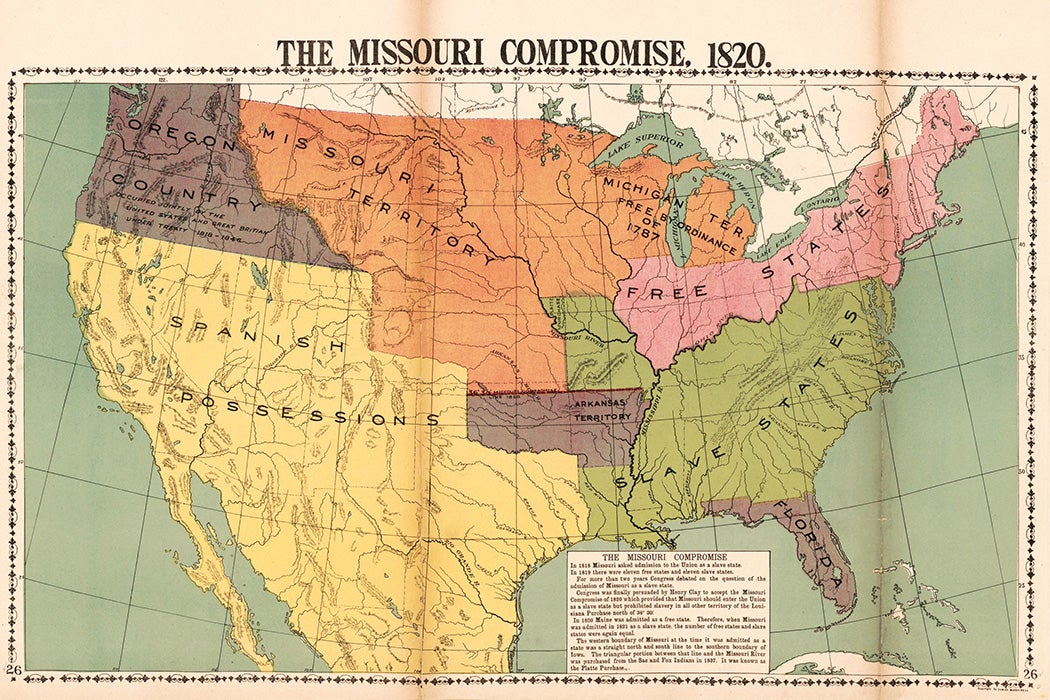
The Missouri Compromise of 1820: A Deal That Bought Time
What Was Going On Before 1820?
In 1819, the United States had 22 states. Eleven of them allowed slavery, and eleven did not. This even split mattered a lot because of how the Senate works. Every state gets two senators, no matter how big or small it is. So as long as the number of slave states and free states stayed equal, neither side could outvote the other in the Senate.
Then Missouri wanted to join the country as a new state. Missouri was part of the huge Louisiana Purchase, and by 1818, many enslaved people were already living there. If Missouri joined as a slave state, the South would suddenly have more power in the Senate than the North. This made a lot of Northern lawmakers nervous.
The Fight in Congress
In 1819, a congressman named James Tallmadge came up with an idea called the Tallmadge Amendment. It would have slowly ended slavery in Missouri. The House of Representatives, where the North had slightly more votes, actually passed this amendment. But the Senate, where slave states and free states had the exact same number of votes, rejected it. Congress got completely stuck. Nobody could agree, and the country was heading toward a real crisis.
Henry Clay's Solution
Henry Clay, who was the Speaker of the House at the time, came up with a plan to fix the problem. People later nicknamed him "The Great Compromiser" because of deals like this one. His plan had three main parts:
- Missouri would join the country as a slave state.
- Maine, which used to be part of Massachusetts, would join at the same time as a free state. This kept the number of slave states and free states equal.
- A senator named Jesse Thomas added one more rule. He drew an imaginary line across the rest of the Louisiana Purchase land at 36 degrees 30 minutes latitude. North of that line, slavery would be banned forever, except in Missouri. South of that line, slavery would still be allowed.
President James Monroe signed this plan into law in March 1820.
There was actually one more twist. Later that year, Missouri wrote its state constitution, and it tried to ban free Black people from even entering the state. This made Congress angry all over again, and Henry Clay had to step in a second time to fix things. Missouri finally became an official state in August 1821.
Why Does This Matter?
At first, the Missouri Compromise did what it was supposed to do. It stopped the fighting and gave the country clear rules about slavery in new territories for over 30 years. But it did not actually solve the real problem. It just pushed the problem down the road.
Thomas Jefferson, who was retired by this time, said the debate felt like "a fire bell in the night." He meant that it scared him because it felt like a warning sign of something much worse coming later. He turned out to be right.
The 36°30′ line eventually fell apart. In 1854, a new law called the Kansas-Nebraska Act basically canceled it. Then in 1857, the Supreme Court ruled in the Dred Scott case that the whole compromise had been unconstitutional in the first place.
Looking back, the Missouri Compromise is important not because it fixed anything, but because of what it showed. It proved that the North and South were becoming more divided over slavery, and it was one of the first big warning signs pointing toward the Civil War.


No comments:
Post a Comment